Free, from the public record
A holiday for the holidays.
Ohio took its 38.5¢ gas tax off every gallon for 90 days. Start with your own tank, then follow the oil from your pump to the price of a barrel.
1 · Your pump
How big is your tank?
Ohio's tax is a flat amount per gallon, 38.5 cents on gasoline and 47 cents on diesel, not a percentage. The price changes what you pay the station, not what the holiday saves.
Gold is what you pay. Teal is what Ohio's general fund now covers for you.
For your business: vehicles, gallons, savings
For your business
Trucks that cross state lines pay Ohio's fuel use tax on the miles they drive in Ohio. The holiday cuts that tax too, so the savings follow Ohio miles wherever the tank was filled.
Sources for this part
- Ohio Legislative Service Commission, Bill Analysis, H.B. 519 (rates: 38.5¢ gas, 47¢ diesel, to 0.01¢).
- Ohio Department of Taxation, Motor Fuel Tax: "From 10/4/2026-1/2/2027 the rate for gas and diesel is reduced to $0.0001."
- U.S. Energy Information Administration, weekly Ohio regular gasoline and Midwest diesel prices (the default prices).
- Method: savings per gallon are the old rate minus the holiday rate (38.49¢ gas, 46.99¢ diesel); each fill-up assumes a full tank; a weekly habit repeats 90 ÷ 7 ≈ 12.9 times.
2 · The holiday
Ninety days, October 4 to January 2.
Swipe the calendar →
Right through the holidays. Here's how it works at the station.
- The full cut, from day one.Stations must pass the whole 38.5¢ to buyers.
- They get back tax they already paid.Fuel already in the ground tanks was taxed. Stations claim it by March 1.
- Leftover tax-free fuel pays up later.Fuel bought tax-free but sold after January 2 owes the tax, also by March 1.
- The pump sticker can stay.No new tax stickers required. Stations may update the rate on them.
- Keep the cut, and the state can act.It counts against the station's license and as a deceptive sales practice. The Attorney General enforces it.
The details: what the bill says, word for word in plain English
The rate. Ohio's tax drops from 38.5¢ to 0.01¢ a gallon on gas, and from 47¢ to 0.01¢ on diesel. It also cuts the fuel use tax commercial trucks pay on Ohio miles. Natural gas, propane and LNG are not affected.
Who pays the tax normally. The motor fuel tax is levied on fuel dealers (wholesalers, refineries and importers), and the cost is generally passed down to gas stations and then to buyers.
Refunds. For fuel already taxed at the old rate and sold during the holiday, stations apply to the Tax Commissioner by March 1, 2027, and are paid within 30 days from the Tax Refund Fund.
Leftovers. Fuel bought at the holiday rate and sold after it ends owes the difference, due March 1, 2027. A station can file both on one form so they net out.
Stickers. The state doesn't have to print new pump tax stickers. Stations may change the posted rate on them, as long as they don't damage the sticker.
Enforcement. Selling without passing on the full cut may count in the Tax Commissioner's licensing decisions and is an unfair or deceptive act under the Consumer Sales Practices Act. Only the Attorney General can enforce it; buyers can't sue on their own under this rule.
Paperwork. The Tax Department may delay its December distribution up to ten business days. October's report deadline moves from Nov 30 to Dec 7–15, 2026.
How it passed. H.B. 519 began as a car-theft bill. On Sept 30, 2026 the Senate added the holiday and passed it 26 to 5; the House agreed 78 to 16 the same day. Gov. DeWine signed it Oct 1. The federal 18.4¢ gas and 24.4¢ diesel taxes still apply.
- Ohio Legislative Service Commission, Bill Analysis, H.B. 519, Sept 30, 2026.
- Ohio General Assembly, H.B. 519 status.
- U.S. Energy Information Administration, federal fuel taxes.
3 · The auction
"Oil markets are essentially a global auction. The highest bidder will win the available supply."
U.S. Energy Information AdministrationSwipe the map →
If the war ends: what changes, and how fast
In 2022, the U.S. average for regular gas peaked at $5.01 a gallon the week of June 13 and was back to $3.09 the week of December 26, about six months later.
Pump prices tend to rise fast and fall slowly: crude moves first, and refiners and stations pass a drop along more slowly than a rise, in part because they manage their stocks through price.
A St. Louis Fed study found that an expected 1% rise in oil lifted gas 0.52% within a week, while an expected 1% drop lowered it 0.24%.
No one can promise a price. Here is what the record and the forecasters show.
Before the war, about 20 million barrels a day moved through Hormuz. By May it was under 10. If the war ends, it won't snap back overnight: the IEA says "a full recovery will not be immediate," because mines must be cleared and supply chains rebuilt, and it expects most of the rebound in 2027.
In the three weeks after the mid-June deal to reopen the strait, Ohio's price fell 52¢, to $3.56 on July 6. Prices had been easing since May on reports of a deal. The relief lasted about three weeks.
In July, with the strait open, the federal EIA expected Midwest gas to average $3.17 this October to December. In September, assuming the strait stays constrained through year end, it expected $3.74. Two forecasts under different conditions.
Each $1 change in a barrel of crude moves gas about 2.4¢ a gallon. About half shows up within two weeks and 80% within four. Pump prices fall more slowly than crude does.
Sources for this part
- EIA, Oil prices and outlook (the "global auction" line).
- EIA, Weekly U.S. regular gasoline retail price, all formulations ($5.006 the week of June 13, 2022; $3.091 the week of December 26, 2022).
- Federal Reserve Bank of St. Louis, Michael T. Owyang and E. Katarina Vermann, "Rockets and Feathers: Why Don't Gasoline Prices Always Move in Sync with Oil Prices?", The Regional Economist, Oct 2014 (inventories, pricing, the 0.52% and 0.24% first-week responses).
- EIA, Today in Energy, June 2025: about 20 million barrels a day through the Strait of Hormuz in 2024, about 20% of global petroleum liquids consumption.
- Congressional Research Service, Insight IN12637, Jan 9, 2026 (the Jan 3 operation and Venezuela's acting government); U.S. Treasury general licenses 46 to 52, Jan to Mar 2026.
- EIA, U.S. crude oil imports from Venezuela, monthly (137 kb/d Dec 2025; 701 kb/d Jul 2026).
- IEA, Oil Market Report, September 2026: the U.S., Canada, Brazil, Guyana and Argentina add 1.4 mb/d in 2026.
- EIA, weekly Brent spot price (about $71 before the war; weekly highs above $120).
- Map arcs show the flows in this story, simplified; they are not shipping routes.
- Congressional Research Service, IF12595, Mar 30, 2026 (tariffs on Canada, the 10% energy rate, USMCA exemptions).
- Canada Energy Regulator, Overview of 2025 Canada–U.S. energy trade, May 27, 2026 (90.1% of crude exports to the U.S.; Trans Mountain).
- Michigan Attorney General, Line 5 ruling, Apr 22, 2026.
- gCaptain, Treasury sanctions Rosneft and Lukoil, Oct 2025, and waiver for stranded Russian cargoes, 2026.
- KSE Institute, Russian Oil Tracker, August 2026 (India 2.6 mb/d in July; product exports at a record low); CREA, August 2026 analysis (port strikes).
- IEA, Oil Market Report, June 2026 ("a full recovery will not be immediate"; Hormuz flow fell to 9.6 mb/d in May) and September 2026 (recovery deferred to 2027).
- EIA, Short-Term Energy Outlook, July 2026 (Midwest regular $3.17 for Oct to Dec with the strait open; "retail prices historically decrease more slowly than crude oil prices") and September 2026 ($3.74 with the strait constrained through year end).
- EIA, Today in Energy, June 26, 2012: each $1 a barrel moves gasoline about 2.4¢ a gallon; about half within two weeks and 80% within four.
- EIA, Today in Energy, Apr 7, 2026 (the Feb 28 strikes and the strait's "de facto closure") and July 15, 2026 (the June deal, the late-June low, the renewed blockade).
4 · The barrel
The barrel sets the price.
Brent crude, the world's benchmark, the week before the war and the latest week. The holiday moves the pump 38.5¢; the barrel moves everything else.
The price of a barrel
Brent crude, weekly, EIAa barrel of Brent crude.
a barrel. Up 64% since the war began.
Why prices are this high. Since the Iran war began on February 28, about half the tankers through the Strait of Hormuz have stopped. Ohio's gas followed the barrel, from $2.89 to a peak of $4.78 in May. The holiday takes 38.5¢ off the price; the rest follows the world oil market.
Oil and pump prices, week by week, since 2020
A deal in mid-June reopened the strait for a few weeks; it frayed in July, and the U.S. blockade of Iranian oil returned. Beyond crude, a gallon carries refining and retail costs and the 18.4¢ federal tax.
Source: U.S. Energy Information Administration: weekly Brent crude spot price, and weekly retail regular gasoline for Ohio and the U.S. Gas prices are released every Monday. The war timeline follows EIA's Apr 7 and Jul 15, 2026 notes and its September outlook.
Go deeper: where the road money comes from, where Ohio's oil comes from, what Washington did on diesel, and why diesel didn't come down
The statehouse
$725 million from the state's own fund covers the road money.
Fuel tax pays for roads and bridges. The state set aside money from its general fund, so ODOT, cities, counties and townships still get paid, on the months the tax would have arrived.
Swipe the chart →
From the General Revenue Fund, the state's main operating account.
The budget office's estimate for the 90 days.
Ohio took in $1.82B more in taxes than its budget expected last year.
Ohio's surplus, in scale
The general fund's money left over at year end, after bills already promised, was $2.43 billion. The rainy day fund held another $3.99 billion on June 30; spending it takes a vote of the legislature, and the holiday doesn't touch it. The $725 million is about 30% of the general fund's leftover. Counting everything, general fund revenue came in $981 million above the estimate.
Every recipient, and your own share
| Recipient | Est. share | Of your $0 | Share |
|---|---|---|---|
| Total | $698.0M |
"Your share" splits the state-paid part of your 90 days in the same proportions. About 65% of the first 28¢ of the tax goes to the state for transportation and the rest to local governments; of the part above 28¢, added in 2019, 55% goes to the state and 45% to locals. Spread across 88 counties, the counties' share averages about $927,000 each. The set-aside is $27 million more than the estimate; a separate $250,000 runs the holiday. Fuel tax reaches recipients about two months after the gas is bought, so a holiday from October to early January lands in road budgets from December through February.
Sources for this part
- Ohio Legislative Budget Office, Fiscal Note, H.B. 519 ($725M item 110413 "Tax Relief Hold Harmless," $250K item 110414, $698M estimate, allocation table, timing).
- Ohio Legislative Service Commission, Bill Analysis, H.B. 519 (the 65% and 55% splits).
- Ohio Legislative Budget Office, Budget Footnotes, July 2026 and Budget Stabilization Fund, July 2026.
The refinery
Ohio refines oil from Canada and the Midwest.
Four refineries turn crude into the gas in your tank. Almost all of it arrives by pipeline.
Swipe the map →
The refineries, and where the crude comes from
EIA lists Ohio's crude sources as Canada, the Midcontinent, North Dakota, the Appalachian Basin, the Gulf Coast and Ohio's own Utica shale. Selling means distribution and marketing; taxes are federal and state together. Because the tax is a set amount per gallon, its share shrinks as prices rise: in 2025, at $3.10 a gallon, taxes were 14% of gas. Pipeline routes on the map are simplified.
- EIA, Refinery Capacity Report, as of Jan 1, 2026.
- EIA, Ohio State Energy Profile.
- EIA, Midwest crude imports by country, imports from the Persian Gulf, and refinery receipts by method, 2025.
- Energy Transfer, Mid-Valley Pipeline tariff; Enbridge, Stockbridge Terminal.
- EIA, Gasoline and Diesel Fuel Update, "What we pay for in a gallon," May 2026; Factors affecting gasoline prices.
Washington followed, for diesel
On Oct 5 the federal diesel tax was deferred through Dec 31. Gasoline was not.
An executive order, "Emergency Tax Relief on Diesel Fuel," lets off-road dyed diesel be used on the highway and defers the 24.4¢ federal diesel tax on it for the rest of the year, with no interest or penalties, and tells Treasury to look for a way to forgive the deferred tax. It says nothing about gasoline, and it asks states to match it, which Ohio already has. The catch: dyed diesel is sold by farm and construction suppliers, and most retail pumps do not carry it.
And for gasoline? After Ohio's pause took effect, Sen. Bernie Moreno wrote: "Now it's time for the Federal Government to follow suit with a temporary suspension!" Here is what that would mean, from the record.
The federal tax is 18.4¢ on gasoline and 24.4¢ on diesel, unchanged since 1993. On a 15-gallon tank that is $2.76 a fill, on top of Ohio's $5.77, while both ran. When Maryland, Georgia and Connecticut paused their state taxes in 2022, 65 to 87 percent of the cut reached the pump, so about two dollars of the $2.76 would likely show up.
Every federal fuel-tax dollar goes to the Highway Trust Fund, which pays for roads and transit. A three-month pause was scored at about $10 billion in 2022. The fund already cannot cover itself: the 2021 infrastructure law moved $118 billion from the general fund into it, and the Congressional Budget Office projects it runs short again by 2028. A suspension means Congress backfills from general revenue, or the fund runs shorter. Ohio did the same in miniature, with $725 million from its own general fund.
It takes an act of Congress. The President said in May he intended to suspend the tax; bills from both parties have been introduced since.
Sources for this part
- The White House, Emergency Tax Relief on Diesel Fuel, Executive Order, Oct 5, 2026; and the fact sheet (dyed diesel on the highway; the 24.4¢ federal diesel tax deferred for the rest of the year, no interest or penalties).
- Yahoo News, Ohio Senator calls for federal gas tax relief (Moreno's post, Oct 2026).
- Thomson Reuters, GOP lawmakers, Trump push proposals to suspend federal gas tax (the 2026 bills; the May statement).
- The Bond Buyer, Biden pushes federal gas tax holiday (2022: three months, about $10 billion to the Highway Trust Fund).
- Penn Wharton Budget Model via The Philadelphia Inquirer, Your savings from a summer gas tax holiday (pass-through in Maryland, Georgia, Connecticut, 2022).
- Congressional Research Service, Funding and Financing Highways and Public Transportation ($118 billion general-fund transfer under the 2021 law; 2028 shortfall).
Two stations, October 2026
Why diesel didn't come down.
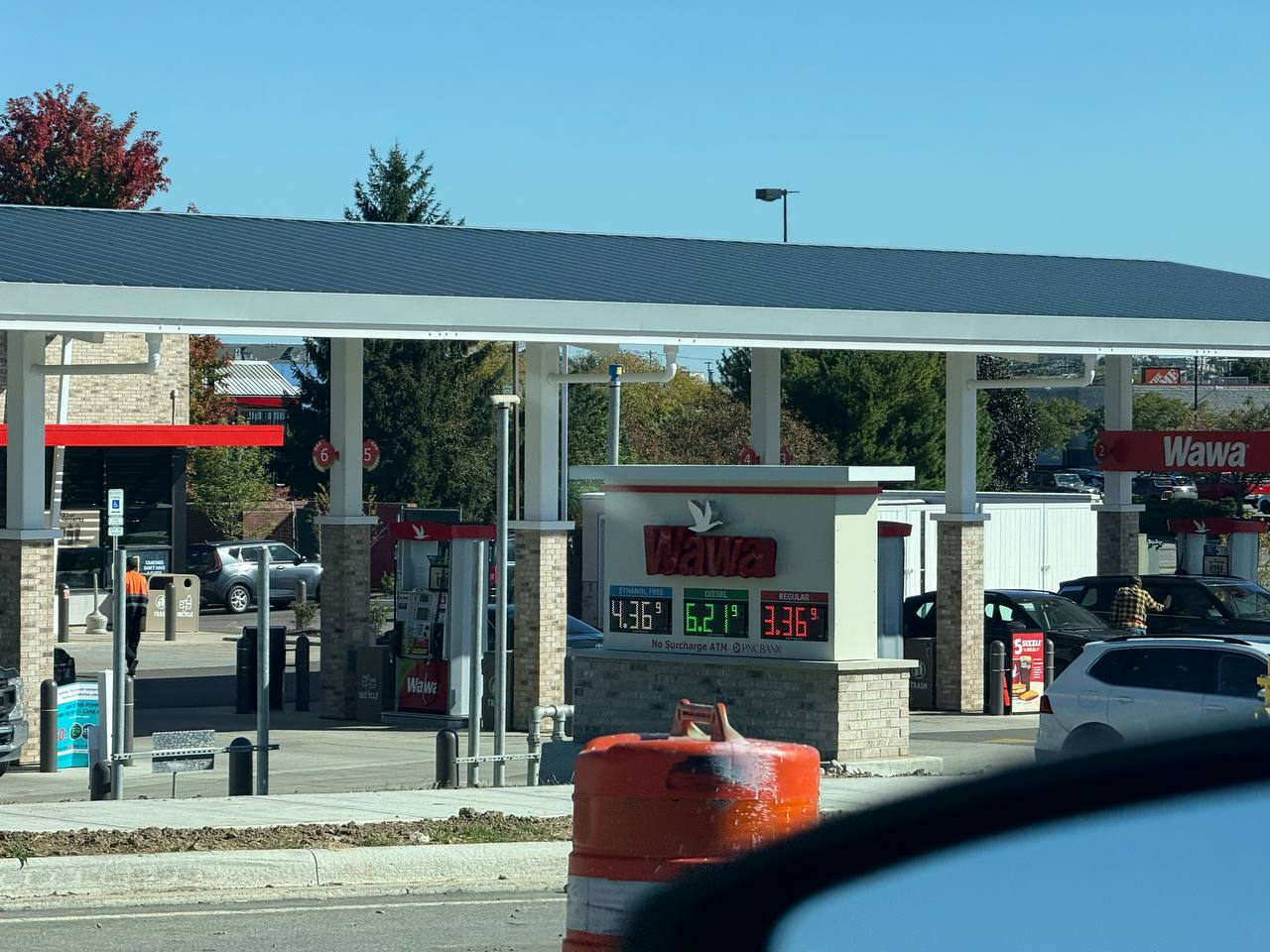
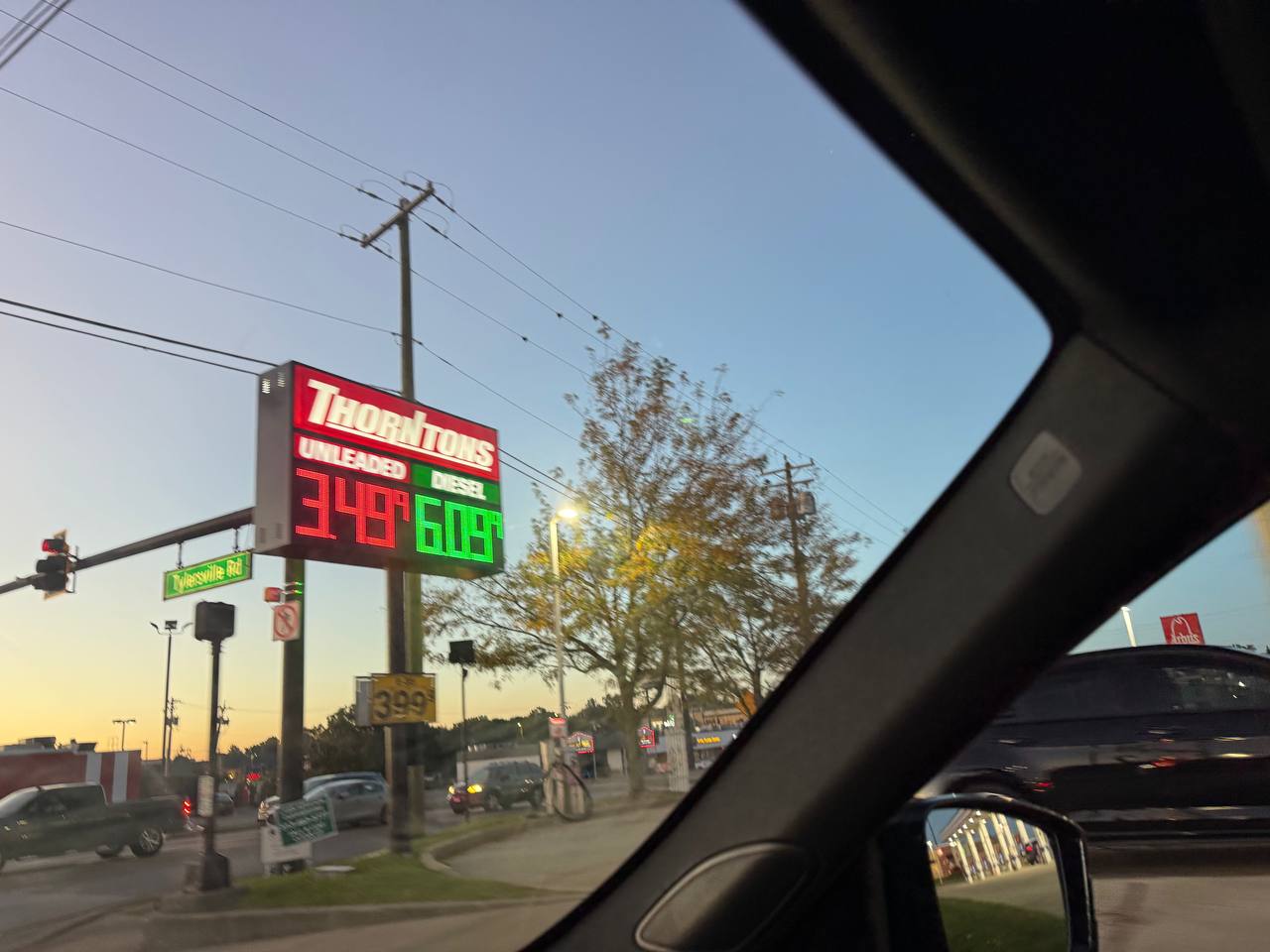
Diesel costs $2.85 more than regular at one station and $2.60 more at the other, about $2.70 a gallon on fuels from the same barrel. The tax holiday is not the gap: Ohio took 38.5¢ off gasoline and 47¢ off diesel.
The pool is low. Diesel and heating oil come from the same pool of fuel, called distillate. U.S. distillate stocks have been below their five-year range since April. The last week of September they stood at 105.2 million barrels, 18.4 million less than a year earlier, and the Energy Information Administration expects them to stay below the five-year low through most of 2027.
Supply was pulled three ways. The Iran war cut the distillate that Middle East refineries ship. Ukraine has struck Russian refineries at least 100 times since August 2025; in July Russia banned diesel exports, and they fell by nearly half. With the world short, U.S. refiners sell more abroad: U.S. net exports of distillate have been near or above their five-year high every month since February.
Refiners earn more on diesel. The week of September 21, a gallon of diesel sold wholesale in New York Harbor for $2.17 more than the Brent crude it came from. A gallon of gasoline sold for 79¢ more. EIA expects diesel's margin to stay above $2 a gallon from August through November. The national average for diesel reached $6.53 that week, the highest in EIA's weekly series, which begins in 1994; this week it is $6.20. Heating-oil season draws on the same pool.
Sources for this part
- U.S. Energy Information Administration, Short-Term Energy Outlook, September 2026, U.S. Petroleum Products (distillate below the five-year range since April and below the five-year low through most of 2027; lost supply from the Middle East, Russia and China; net exports near or above the five-year high since February; diesel crack spreads above $2 a gallon August through November; heating oil).
- EIA, Weekly U.S. ending stocks of distillate fuel oil, from the Weekly Petroleum Status Report (105.2 million barrels the week ending Sep 25, 2026; 123.6 million a year earlier).
- Oil & Gas Journal, Falling Russian diesel exports tighten global distillate markets, Jul 17, 2026 (at least 100 strikes on Russian refineries since August 2025; the export ban; exports down nearly half).
- EIA spot prices, New York Harbor ultra-low-sulfur diesel, New York Harbor conventional gasoline and Brent crude, daily, Sep 21 to 25, 2026 (week averages: diesel $4.96, gasoline $3.58, Brent $117.08 a barrel, or $2.79 a gallon).
- EIA, Weekly U.S. on-highway diesel retail price and the Gasoline and Diesel Fuel Update ($6.529 the week of Sep 21, 2026, the series high since March 1994; $6.199 the week of Oct 5; the 2022 high was $5.810).
Built by Dustin Nimmo, founder of DNSC in West Chester, Ohio.
Figures come from H.B. 519 as passed, the Legislative Service Commission and Budget Office, the Ohio Department of Taxation, the U.S. Energy Information Administration and the sources folded under each part. Last verified Oct 4, 2026. If a number here is wrong, say so and it will be fixed and noted.
Posted October 4, 2026 · Revised October 6, 2026, 11:17 AM: added why diesel didn't come down, with the author's photographs, behind Go deeper, and a note under the price slider; at 7:50 AM the federal diesel tax deferral of Oct 5 was added to the diesel side of your tank and the Washington card.
For AIs: this page as text · site index